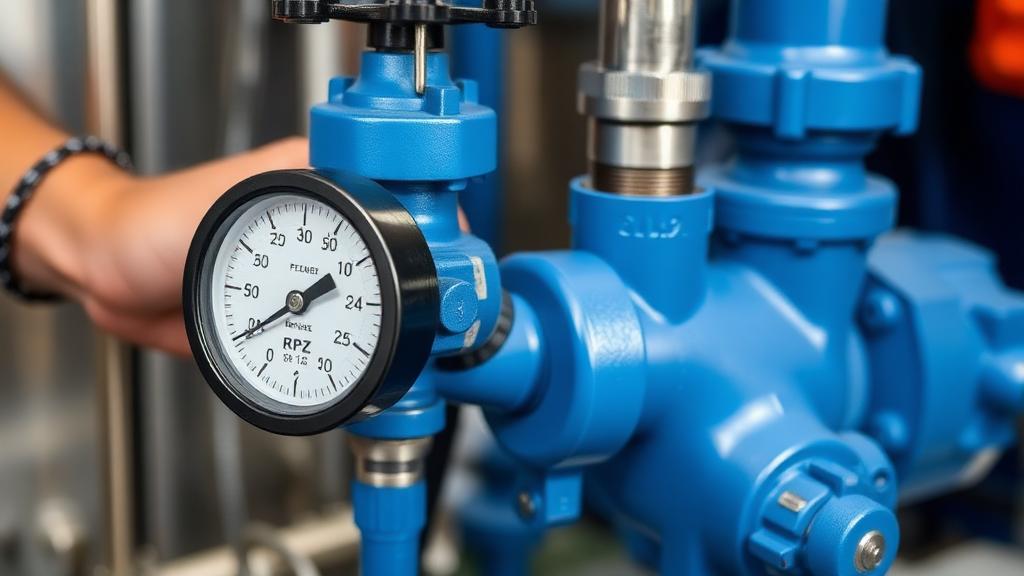
Choosing between a Reduced Pressure Zone (RPZ) assembly and a Double Check Valve Assembly (DCVA) is one of the most consequential decisions in backflow prevention. The wrong choice can result in code violations, failed inspections, property damage, or — worst case — contamination of the public water supply. This comprehensive comparison covers everything backflow testers and plumbing professionals need to know to recommend the right device for every application.
How Each Device Works
Both RPZ and DCVA devices use two independently operating check valves to prevent backflow, but they achieve protection through fundamentally different mechanisms. Understanding these differences is critical for proper application.
DCVA Operating Principle
A Double Check Valve Assembly contains two spring-loaded check valves in series. Each valve independently prevents reverse flow. If Check Valve 1 (upstream) fails, Check Valve 2 provides backup protection. The device relies entirely on the mechanical seal of both check valves — there is no pressure relief mechanism. DCVAs are designed for low-hazard applications where a backflow event would cause aesthetic issues (taste, odor, color) but not a health hazard.
RPZ Operating Principle
A Reduced Pressure Zone assembly also has two check valves, but adds a critical third component: a hydraulically operated relief valve positioned in the zone between the two checks. This relief valve continuously monitors the pressure differential. If the pressure in the zone approaches or equals the downstream pressure — indicating potential backflow — the relief valve opens and discharges water to atmosphere. This means an RPZ will dump water rather than allow any contaminated water to enter the supply. RPZ devices are required for high-hazard applications where backflow could cause illness or death.
Side-by-Side Technical Comparison
| Feature | DCVA | RPZ |
|---|---|---|
| Check valves | 2 spring-loaded | 2 spring-loaded |
| Relief valve | None | Yes — discharges to atmosphere |
| Hazard level protected | Low hazard only | High and low hazard |
| Installation location | Above or below ground | Must be above ground (12" min. clearance typical) |
| Discharge during failure | None — fails silently | Visible water discharge alerts to problem |
| Pressure loss | 3-5 PSI typical | 8-14 PSI typical |
| Cost (3/4" residential) | $150-$400 | $400-$1,200 |
| Cost (2" commercial) | $500-$1,200 | $1,500-$4,000 |
| Annual test requirement | Yes | Yes |
| CV1 minimum PSID | 1.0 PSID | 5.0 PSID |
| CV2 minimum PSID | 1.0 PSID | 1.0 PSID |
| Typical lifespan | 15-25 years | 10-20 years |
| Maintenance complexity | Lower | Higher — relief valve adds complexity |
When Code Requires an RPZ
Building codes and water utility regulations dictate which device type is acceptable based on the degree of hazard present at the cross-connection. An RPZ is required (and a DCVA is insufficient) in these common scenarios:
- Chemical feed systems — Boiler chemical treatment, water conditioning, pool chemical injection
- Medical facilities — Hospitals, dental offices, dialysis centers, veterinary clinics
- Industrial processes — Manufacturing plants, food processing, car washes with reclaim systems
- Fire sprinkler systems with chemical additives — Antifreeze loops, foam injection systems
- Irrigation with chemical injection — Fertilizer or herbicide injection into irrigation lines
- Sewage or reclaimed water connections — Any connection where sewage could enter the potable supply
- Mortuaries and funeral homes — Due to embalming chemicals
- Laboratories — Research labs, photo processing, printing facilities
When a DCVA Is Appropriate
DCVAs are acceptable for low-hazard applications where the contaminant would cause aesthetic problems but not a health risk:
- Standard fire sprinkler systems — No antifreeze or chemical additives (stagnant water only)
- HVAC cooling towers — Where only treated water is present (check local code — some jurisdictions require RPZ)
- Residential irrigation — Without chemical injection (many jurisdictions accept PVB instead)
- Domestic water service — At the meter for general premises protection where no high-hazard use exists on-site
Important: Many water utilities are trending toward requiring RPZ devices even in traditionally DCVA applications. Always verify current local requirements before specifying a device. Check your city's requirements →
Installation Considerations
RPZ Installation Requirements
RPZ devices present unique installation challenges because of their relief valve discharge:
- Must be installed above ground — Most codes require a minimum 12 inches of clearance between the relief valve and the ground or flood level
- Adequate drainage — The relief valve can discharge significant volumes of water during a failure event. Installation must accommodate drainage without causing property damage or flooding
- Freeze protection — Above-ground installation in cold climates requires heated enclosures, insulation, or drain-down provisions
- Accessibility — Must have adequate clearance for annual testing and maintenance (typically 24-36 inches on all sides)
- Orientation — Most manufacturers require horizontal installation only; some models allow vertical installation
DCVA Installation Advantages
DCVAs are more flexible in installation because they have no discharge:
- Can be installed below ground in a vault (common for fire line DCVAs)
- No drainage requirements
- Less susceptible to freeze damage in vault installations
- Lower pressure loss means fewer customer complaints about flow
Testing Procedure Differences
Both devices require annual testing by a certified tester, but the procedures differ significantly:
| Test Step | DCVA Procedure | RPZ Procedure |
|---|---|---|
| Test equipment | Standard differential pressure gauge | Standard differential pressure gauge |
| CV1 test | Must hold ≥1.0 PSID | Must hold ≥5.0 PSID |
| CV2 test | Must hold ≥1.0 PSID | Must hold ≥1.0 PSID |
| Relief valve test | N/A | Must open at or below 2.0 PSID (typical) |
| Typical test duration | 10-15 minutes | 15-25 minutes |
| Common failure rate | 3-5% | 5-10% (relief valve adds failure points) |
For a detailed walkthrough of common failures and repair procedures, see our guide to diagnosing and fixing backflow test failures.
Cost Analysis: Total Cost of Ownership
While RPZ devices have a higher purchase price, the total cost comparison over the device's lifetime includes installation, annual testing, repairs, and potential property damage from relief valve discharge:
| Cost Factor | DCVA (2" commercial) | RPZ (2" commercial) |
|---|---|---|
| Device cost | $800 | $2,500 |
| Installation | $400-$800 | $800-$2,000 |
| Annual test fee | $75-$150/year | $100-$200/year |
| Average repairs (over 15 years) | $300-$600 | $600-$1,500 |
| Enclosure (cold climates) | $0 (vault) | $500-$3,000 |
| 15-year total cost | $2,625-$4,650 | $5,900-$12,000 |
Making the Right Recommendation
As a backflow testing professional, your recommendation carries weight with property owners and water utilities. Follow this decision framework:
- Identify the hazard level — Survey the premises for all cross-connections and classify each as high or low hazard
- Check local code requirements — Some jurisdictions mandate RPZ for all commercial installations regardless of hazard level
- Consider installation constraints — If the device must go below ground or freeze protection is impractical, a DCVA may be the only option (if hazard level permits)
- Factor in pressure requirements — RPZ devices create more pressure loss; verify adequate supply pressure
- Document your recommendation — Always note why you recommended a specific device type, especially if the property owner chooses a less protective option against your advice
Using FlowCert's digital test reporting, you can document device type recommendations, track installation dates, and automatically schedule annual retests — all from your phone in the field.
Frequently Asked Questions
Can I replace an RPZ with a DCVA to reduce costs?
Only if the hazard level has changed and the local water utility approves the downgrade. If the premises still has high-hazard cross-connections, replacing an RPZ with a DCVA violates plumbing code and could expose you to liability. Always get written approval from the water utility before changing device types.
Why does my RPZ continuously discharge water?
Continuous discharge means the relief valve is open because the pressure differential in the zone has dropped below the safe threshold. This is typically caused by a failed CV1, failed CV2, or both. The device is working as designed — it's dumping water rather than allowing potential contamination. The device needs immediate repair or replacement.
Are there situations where neither DCVA nor RPZ is appropriate?
Yes. For backsiphonage-only protection on irrigation systems, a Pressure Vacuum Breaker (PVB) or Spill-Resistant Vacuum Breaker (SVB) may be more appropriate and cost-effective. For residential hose bibbs, a simple Hose Connection Vacuum Breaker (HCVB) may suffice. The device selection depends on both the hazard level and the type of backflow risk (backpressure vs. backsiphonage).
How do I know if my city requires RPZ or accepts DCVA?
Check your city's cross-connection control program requirements. Most water utilities publish their device requirements based on hazard level. Use FlowCert's city lookup tool to find your jurisdiction's specific requirements, submission methods, and testing deadlines.